
Rancho Santa Margarita Previous Resident Sources
Previous residents appear in layers. For Rancho Santa Margarita, the deed index is best for recorded ownership. A reverse directory may show a listed occupant or subscriber. A city or regional directory may supply a household and occupation. Census schedules show historical households in the geography used by the enumerator. Permits date physical changes and people connected to a project. Newspapers, obituaries, and probate can explain a departure or family connection.
| Source | Years or era | Where held | What it shows |
|---|---|---|---|
| Recorder index and copies | Orange County from 1889; modern RSM chiefly 1986 forward | OC Clerk-Recorder | Recorded owners, liens, easements, legal descriptions |
| Building permits | City files after 2000; earlier county-era records need inquiry | RSM or Orange County | Applicants, contractors, work scope, dates, inspections |
| Regional reverse directories | Modern community era; exact years not inventoried | OCPL and licensed databases | Listed contacts or occupants by address |
| Orange County Register | 1987 to current in NewsBank | OCPL licensed resources | Community news, legal notices, obituaries |
| Federal census | Public through 1950 | NARA and library databases | Historical households in older enumeration geography |
| Probate and obituary | Event and case dependent | Superior Court and OCPL | Death, family, heirs, and estate trail |
Choose the source by the question. Title history begins with the APN. Household history begins with a directory or newspaper. A death or estate question begins with obituary and probate.
Rancho Santa Margarita Past Residents: APN First
An APN is the durable property key. The address can be renamed, used with a different postal city, or remembered without a unit or tract detail. The Community Viewer accepts an address or APN and can show parcel lines, city boundary, HOA, zoning, utilities, schools, water districts, and service layers. The map is the first bridge between a present location and an older record.
Write down the APN, situs, owner mailing address, tract or lot if shown, HOA, and the date of the map check. In Rancho Santa Margarita, take those facts to the assessment roll and recorder index. A past-resident search should not begin by putting a guessed surname into a broad directory.
The RSM Community Viewer is free, but the city's GIS disclaimer says map data may be incomplete. Verify title and parcel facts with the county custodian.
Deeds for Previous Rancho Santa Margarita Residents
Use the Orange County Assessor to identify the present assessed owner and APN, then search the owner as a grantee in the Grantor/Grantee Index. The acquisition deed names the seller or grantor, gives a recording date, and carries a legal description. That seller becomes the next search name. The legal description is the anchor when street labels or postal details vary.
- Open the parcel in the city GIS viewer and save the APN.
- Check the assessment roll for the current owner, situs, and mailing context.
- Search the owner as grantee in the recorder index.
- Note seller, legal description, date, document type, and instrument number.
- Search the seller as an earlier grantee and repeat backward.
Orange County's online deed search is an index only. It does not show images, and recorder staff do not perform the search for callers. For a Rancho Santa Margarita address, copies cost $1 per page plus $1 certification per document or map, with the identifying convention depending on the record's era.
Note: A Rancho Santa Margarita deed chain becomes historical only when each seller, legal description, date, and APN align.
Earlier Residents in Rancho Santa Margarita
Grantor means the party conveying or encumbering an interest. Grantee means the party receiving it. A chain of title is the sequence of recorded transfers that connects one owner to an earlier owner. A legal description identifies the land in the instrument and can be more stable than an address.
- Grantor
- The party giving, selling, or recording an interest.
- Grantee
- The party receiving an interest in the recorded instrument.
- Chain of title
- The linked sequence of recorded transfers for one parcel.
- Legal description
- Recorded land language, often tied to a tract, lot, or metes-and-bounds description.
Try surname variants, initials, trust names, entity names, and married names. Keep the date range just before the known deed. Same-name parties and owners with more than one parcel make name-only chaining risky. Match the legal description and APN at each step.
The Orange County court records-copy page is the source shown in the previous residents capture.
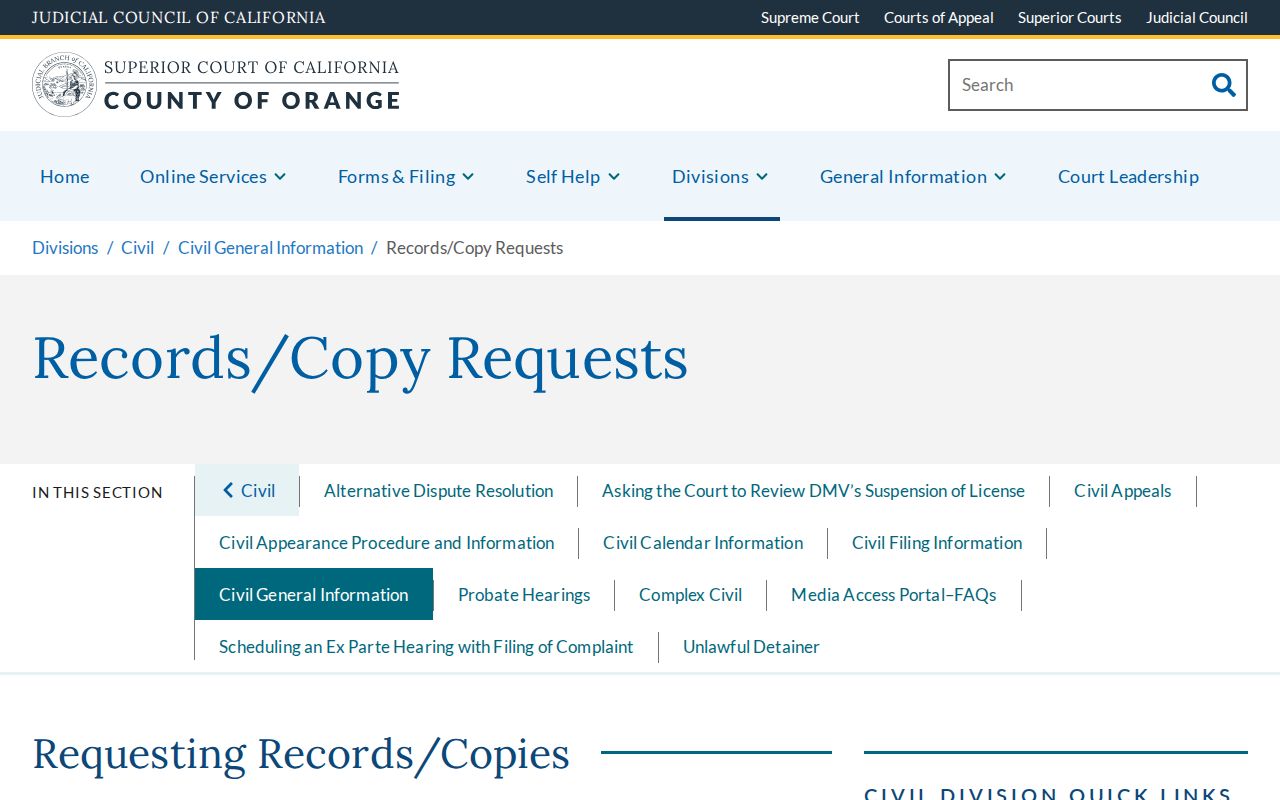
The court copy-request page is a useful reminder that older and deeper historical records may need a form, a fee, or a counter route rather than an instant screen result.
Rancho Santa Margarita Previous Residents: 1982 Divide
Orange County copy instructions distinguish pre-1982 and 1982-forward records. Older copies may require book, page, and instrument information. Newer documents use a recording year plus a six-digit instrument number. This is an index and copy-order convention, not a promise that every image is online.
Orange County's recorder system began in the county's 1889 era. Modern Rancho Santa Margarita deed history largely follows the community's post-1986 development. For a predevelopment parcel, move from the modern deed to a tract map, subdivision instrument, aerial, or county planning record rather than assuming an old city address existed.
The official copy workflow explains the identifiers and mail route to 601 N. Ross St., Santa Ana, CA 92701. Carry the instrument pointer into any request.
Rancho Santa Margarita Past Residents and Permits
Building permits can date new construction, additions, pools, reroofing, solar, plumbing, heating, and demolition. Files may name an owner-builder, architect, contractor, applicant, inspection, or final status. They help explain when the physical house changed. They do not prove who lived there.
The custodian changes at cityhood. Rancho Santa Margarita incorporated on January 1, 2000, so post-2000 municipal files start with Development Services. Earlier work may remain with Orange County. For Rancho Santa Margarita previous residents, a request should name the address, permit number, project, or date range and should ask whether the file is imaged, in hard copy, or held by another agency.
City permit forms and the Development Services page give the current route. Earlier county-era material may need a county archive inquiry.
Note: Rancho Santa Margarita permit files date physical work, not the complete household history of a parcel.
Rancho Santa Margarita Previous Residents in Directories
Because first homes sold in 1986, regional telephone and reverse directories are most promising for the modern community era. Search under Rancho Santa Margarita, Mission Viejo, Trabuco Canyon, Saddleback Valley, and named developments. An exact title and year run was not officially inventoried, so ask the OCPL catalog or reference desk instead of claiming a volume exists.
A reverse entry may show a listed subscriber, telephone number, address, spouse, occupation, business address, or symbol. It can lag a move or omit an unlisted number. Pair it with a deed, permit, newspaper, or assessment record. The historical Rancho Santa Margarita city directory page covers how to read the collections; a Rancho Santa Margarita previous resident search uses the entry as one point in a time line.
Regional labels are not noise. They are how a new city appears in older shelves.
Newspapers for Rancho Santa Margarita Past Residents
NewsBank's Orange County Register coverage starts in 1987, one year after the first planned-community homes sold. That makes the newspaper a strong bridge for previous residents. Search a name with the address, neighborhood, community event, legal notice, school, business, or obituary term. A newspaper can show when a family appeared, moved, celebrated, or was remembered.
The local library's older microfilm and digitized issues can reach predecessor-community history. For a death, OCPL recommends the California Death Index from 1940 to 1997, FamilySearch, Social Security Death Index, and Register microfilm. Newspaper evidence is secondary, so verify the event with the custodian when a certified fact matters.
The OCPL obituary tips page is the source shown in the previous residents newspaper and death-index capture.
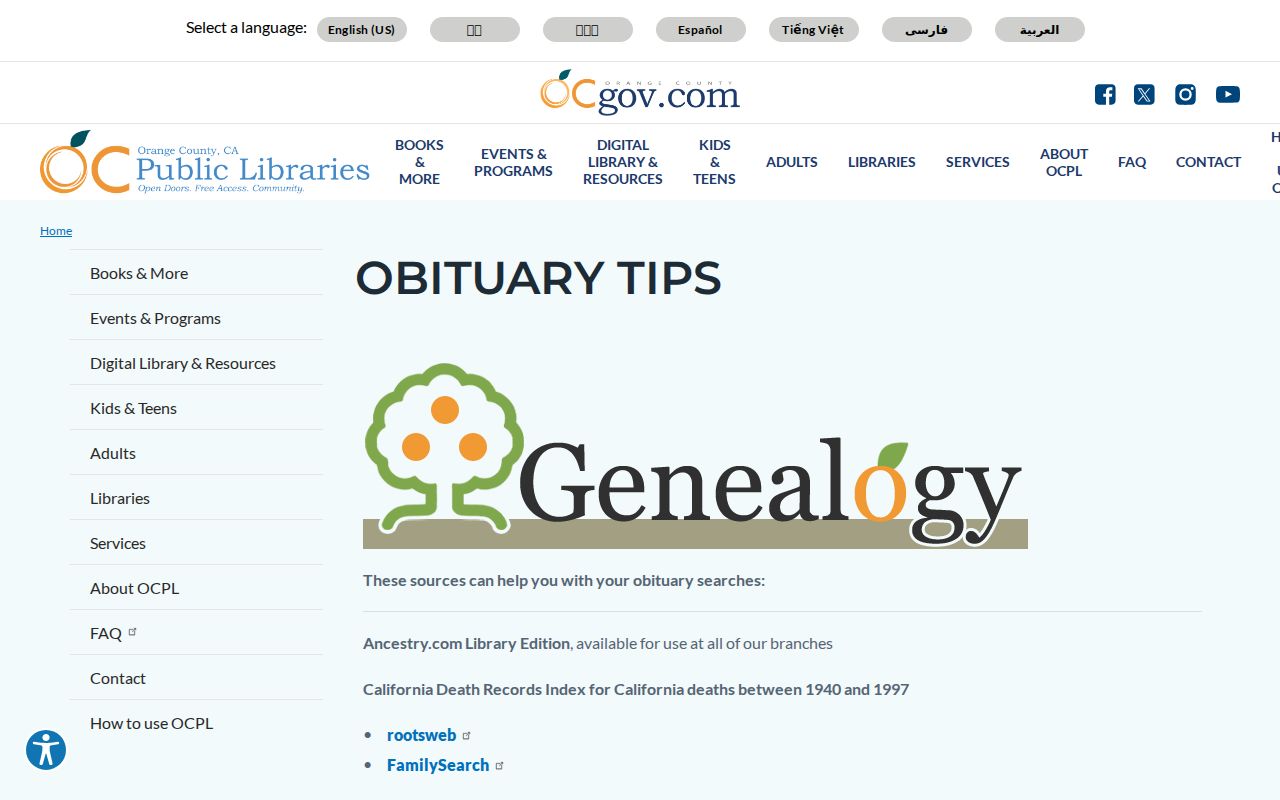
OCPL obituary guidance supplies a practical fallback when a prior household is absent from a directory volume.
Rancho Santa Margarita Past Residents and Sanborn
Federal census records are public through 1950, but the present city and its street grid did not exist then. For a Rancho Santa Margarita past-resident question, use historical enumeration geography, ranch, township, and predecessor community labels. Census records can show a household snapshot, not continuity with a modern street number.
Sanborn maps are also a weak local fit. No Rancho Santa Margarita city sheets were found in the research, and urban development came late. The Library of Congress notes that street names and numbers can change. For this area, tract maps, aerials, deeds, county permits, and subdivision records are more likely to bridge an open or ranch parcel to a later home.
The Orange County Historical Commission resource page is the source shown in the historical-records capture.
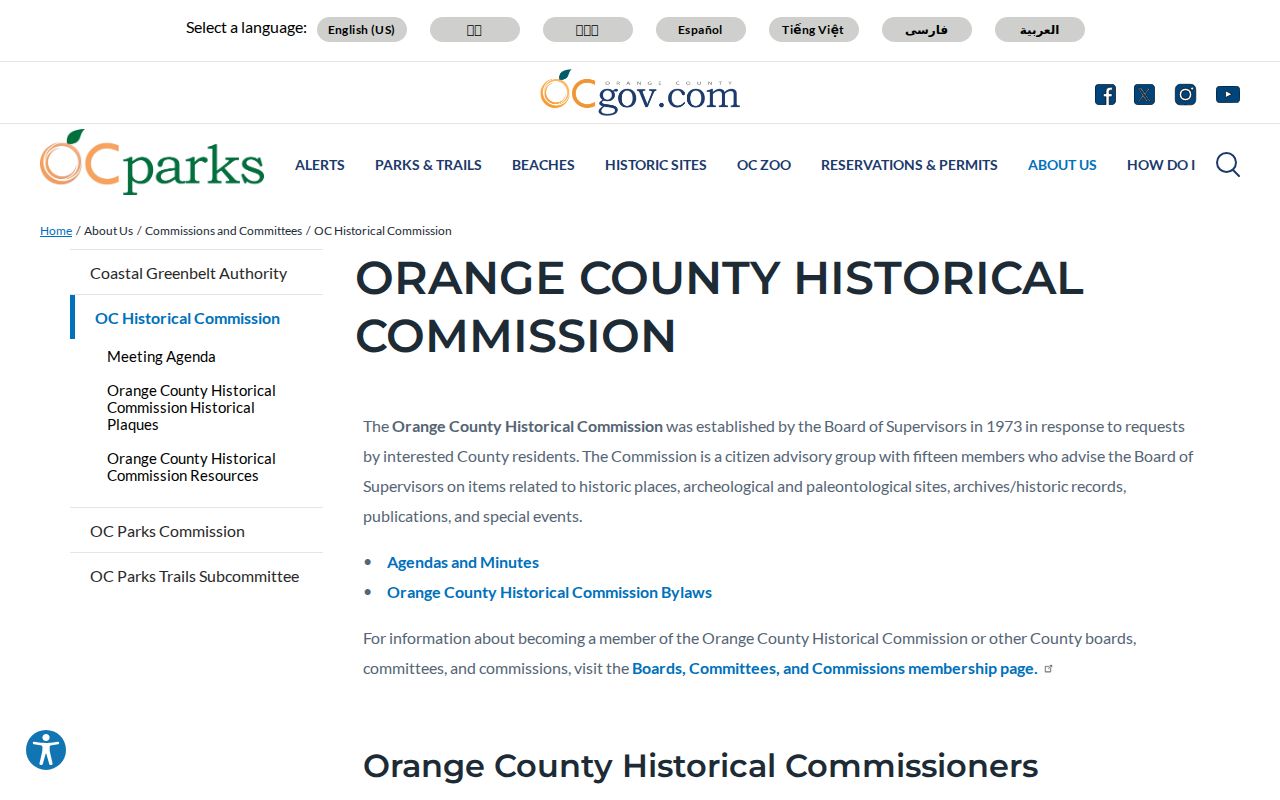
The county historical-resource contact can help route older land and government-history questions when a modern city file does not reach far enough back.
Note: Rancho Santa Margarita past-resident research should preserve historical geography instead of forcing a modern street label into an old source.
Households of Previous Rancho Santa Margarita Residents
Owners are only half the story. A directory, newspaper, or census can suggest who lived at an address. An obituary can connect a former resident to spouse, children, prior places, service, or cemetery. Probate can identify the estate, petitioner, heirs, and later transfer. Use those sources in sequence, but keep each fact tied to its own date and source.
A practical household flow is directory entry to date and address to APN or tract to deed or permit to obituary or probate. The flow is strongest when the address, person, and time all align. A conflict may reflect a delayed directory, a move, a different postal label, or a same-name party.
House-history limit. Previous-resident research in Rancho Santa Margarita is for lawful family history and property history. Do not use a past-resident trail to harass, track, threaten, or harm a living person.
Confirm important conclusions with the Orange County Clerk-Recorder, Superior Court, OCPL, or another custodian. A careful account of what cannot be found is better than an invented household.